Segment-Tree Optimization

AtCoder
IDarc164_e
Time2000ms
Memory256MB
Difficulty
There is a sequence of $N$ terms, and $Q$ queries will be given on this sequence. The $i$\-th query is for the interval $[L_i, R_i]$ (the interval $[a,b]$ is a set of integers between $a$ and $b$, inclusive). You will answer this problem using a binary tree that satisfies the following conditions. Here, $i,j,k$ represent integers. * Each node has an interval. * The root node has the interval $[1, N]$. * The node with the interval $[i, i]$ is a leaf. Also, the interval of a leaf can be represented as $[i,i]$. * Each non-leaf node has exactly two children. Also, if the interval of a non-leaf node is $[i,j]$, the intervals of the children of this node are $[i,k]$ and $[k+1,j]$ ($i\leq k<j$). In this binary tree, when a query for the interval $[L,R]$ is given, a search is performed recursively according to the following rules. 1. Initially, the root is investigated. 2. When a node is investigated, if the interval of this node is included in $[L, R]$, its descendants are not investigated. 3. When a node is investigated, if the interval of this node have no intersection with $[L,R]$, its descendants are not investigated. 4. When a node is investigated, if neither 2. nor 3. applies, the two child nodes are investigated. (It can be shown that either 2. or 3. always applies to a leaf node.) When answering $Q$ queries, let $d$ be the maximum depth (distance from the root) of the investigated nodes, and $c$ be the total number of times nodes of depth $d$ are investigated. Here, if multiple nodes of depth $d$ are investigated in a single query, or if the same node is investigated in multiple queries, all those investigations count separately. You want to design the binary tree to minimize $d$, and then to minimize $c$ while minimizing $d$. What are the values of $d$ and $c$ then? ## Constraints * $2\leq N \leq 4000$ * $1\leq Q \leq 10^5$ * $1\leq L_i \leq R_i \leq N$ $(1\leq i \leq Q)$ * All input values are integers. ## Input The input is given from Standard Input in the following format: $N$ $Q$ $L_1$ $R_1$ $L_2$ $R_2$ $\vdots$ $L_Q$ $R_Q$ [samples]
Samples
Input #1
6 4
2 3
3 4
2 4
3 3
Output #1
3 4

We have an interval $[1,6]$, and queries for the intervals $[2,3],[3,4],[2,4],[3,3]$. Here, if you use the binary tree shown in the figure below,

*   for the first query, nodes $1,2,3,4,5$ are investigated, and the maximum depth among these is $2$ for nodes $4,5$;
*   for the second query, nodes $1,2,3,4,5,6,7,8,9$ are investigated, and the maximum depth among these is $3$ for nodes $8,9$;
*   for the third query, nodes $1,2,3,4,5,6,7$ are investigated, and the maximum depth among these is $2$ for nodes $4,5,6,7$;
*   for the fourth query, nodes $1,2,3,4,5,8,9$ are investigated, and the maximum depth among these is $3$ for nodes $8,9$.

Therefore, in this case, $d=3$, and nodes of depth $3$ were investigated four times ー nodes $8,9$ in the second query and nodes $8,9$ in the fourth query ー so $c=4$. In fact, this is an optimal method.
(In the figure, the upper row shows the node number, and the lower row shows the interval of each node.)
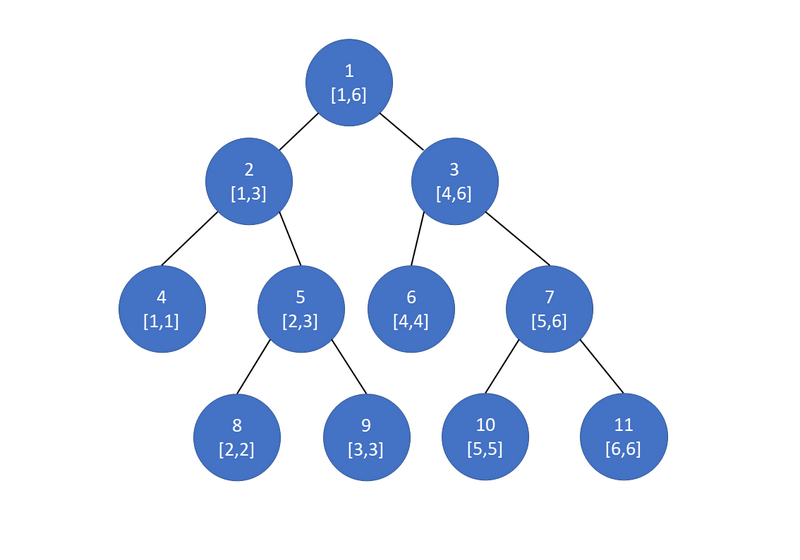
![image](https://img.atcoder.jp/arc164/c5776dc7ace92d9830788319820bed2d.png)
Input #2
12 6
1 10
2 7
3 6
4 9
5 8
11 12
Output #2
4 4
API Response (JSON)
{
  "problem": {
    "name": "Segment-Tree Optimization",
    "description": {
      "content": "There is a sequence of $N$ terms, and $Q$ queries will be given on this sequence. The $i$\\-th query is for the interval $[L_i, R_i]$ (the interval $[a,b]$ is a set of integers between $a$ and $b$, inc",
      "description_type": "Markdown"
    },
    "platform": "AtCoder",
    "limit": {
      "time_limit": 2000,
      "memory_limit": 262144
    },
    "difficulty": "None",
    "is_remote": true,
    "is_sync": true,
    "sync_url": null,
    "sign": "arc164_e"
  },
  "statements": [
    {
      "statement_type": "Markdown",
      "content": "There is a sequence of $N$ terms, and $Q$ queries will be given on this sequence. The $i$\\-th query is for the interval $[L_i, R_i]$ (the interval $[a,b]$ is a set of integers between $a$ and $b$, inc...",
      "is_translate": false,
      "language": "English"
    }
  ]
}
Full JSON Raw Segments