4 4
1 2
2 3
3 4
4 2
0 1 0 1
Yes For example, consider starting from vertex $1$. In the first operation, move to vertex $2$ and change the color of the vertex $1$ from white to black. This change in the graph is shown in the figure below (the vertex circled is the current vertex). Then, if you move to vertices $3$, $4$, and $2$ in order, the colors of vertices $1,2,3,4$ will then be black, white, black, and white, respectively. Therefore, you can move to vertex $1$ in the next operation, returning to the starting point. 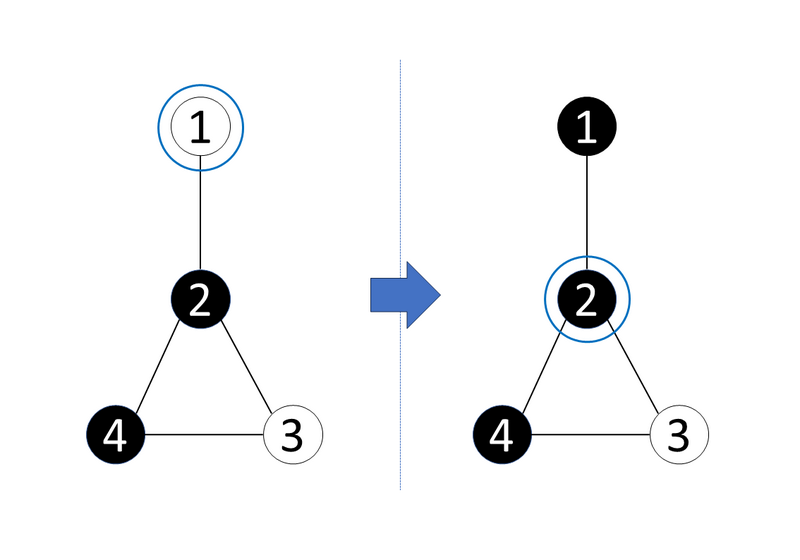
5 6
1 2
2 3
3 4
4 5
1 4
2 5
0 1 0 1 0
No

In this graph, no matter which vertex you choose as the starting point, you cannot return to the starting point by making moves that satisfy the conditions.
{
  "problem": {
    "name": "Switching Travel",
    "description": {
      "content": "There is a simple connected undirected graph with $N$ vertices numbered from $1$ to $N$. This graph has $M$ edges, and the $i$\\-th edge connects two vertices $a_i$ and $b_i$. Each vertex has a color, ",
      "description_type": "Markdown"
    },
    "platform": "AtCoder",
    "limit": {
      "time_limit": 2000,
      "memory_limit": 262144
    },
    "difficulty": "None",
    "is_remote": true,
    "is_sync": true,
    "sync_url": null,
    "sign": "arc164_b"
  },
  "statements": [
    {
      "statement_type": "Markdown",
      "content": "There is a simple connected undirected graph with $N$ vertices numbered from $1$ to $N$. This graph has $M$ edges, and the $i$\\-th edge connects two vertices $a_i$ and $b_i$.\nEach vertex has a color, ...",
      "is_translate": false,
      "language": "English"
    }
  ]
}