5
1 2
3 1
4 3
3 5
2
2 6
5 7
Yes 5 6 6 5 7 The figure below shows the tree when Takahashi fell asleep. For each vertex, the integer written beside it represents the index of the vertex, and the integer written into the vertex is the integer written by Takahashi. 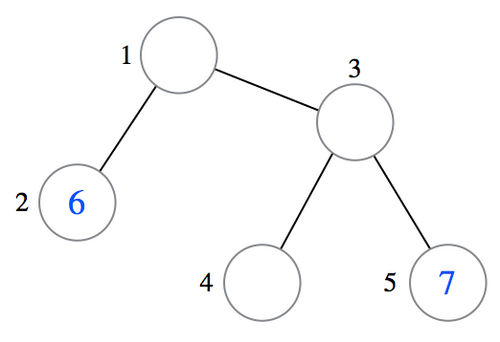 Aoki can, for example, satisfy the condition by writing integers into the remaining vertices as follows: 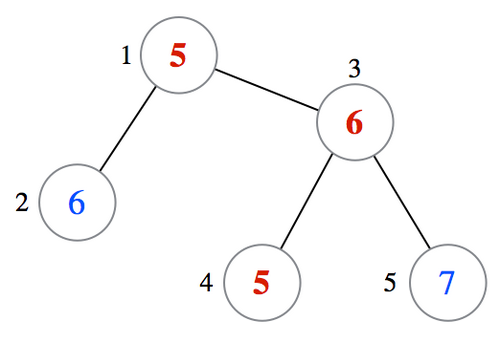 This corresponds to Sample Output 1. Note that other outputs that satisfy the condition will also be accepted, such as: Yes 7 6 8 7 7
5
1 2
3 1
4 3
3 5
3
2 6
4 3
5 7
No
4
1 2
2 3
3 4
1
1 0
Yes
0
-1
-2
-3

The integers written by Aoki may be negative or exceed $10^6$.
{
  "problem": {
    "name": "Integers on a Tree",
    "description": {
      "content": "We have a tree with $N$ vertices. The vertices are numbered $1, 2, ..., N$. The $i$\\-th ($1 ≦ i ≦ N - 1$) edge connects the two vertices $A_i$ and $B_i$. Takahashi wrote integers into $K$ of the verti",
      "description_type": "Markdown"
    },
    "platform": "AtCoder",
    "limit": {
      "time_limit": 2000,
      "memory_limit": 262144
    },
    "difficulty": "None",
    "is_remote": true,
    "is_sync": true,
    "sync_url": null,
    "sign": "arc063_c"
  },
  "statements": [
    {
      "statement_type": "Markdown",
      "content": "We have a tree with $N$ vertices. The vertices are numbered $1, 2, ..., N$. The $i$\\-th ($1 ≦ i ≦ N - 1$) edge connects the two vertices $A_i$ and $B_i$.\nTakahashi wrote integers into $K$ of the verti...",
      "is_translate": false,
      "language": "English"
    }
  ]
}