A _balancing network_ is an abstract device built up of $N$ wires, thought of as running from left to right, and $M$ _balancers_ that connect pairs of wires. The wires are numbered from $1$ to $N$ from top to bottom, and the balancers are numbered from $1$ to $M$ from left to right. Balancer $i$ connects wires $x_i$ and $y_i$ ($x_i < y_i$).
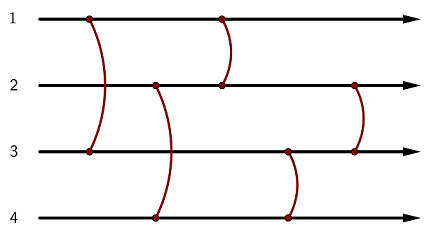
Each balancer must be in one of two states: _up_ or _down_.
Consider a token that starts moving to the right along some wire at a point to the left of all balancers. During the process, the token passes through each balancer exactly once. Whenever the token encounters balancer $i$, the following happens:
* If the token is moving along wire $x_i$ and balancer $i$ is in the down state, the token moves down to wire $y_i$ and continues moving to the right.
* If the token is moving along wire $y_i$ and balancer $i$ is in the up state, the token moves up to wire $x_i$ and continues moving to the right.
* Otherwise, the token doesn't change the wire it's moving along.
Let a state of the balancing network be a string of length $M$, describing the states of all balancers. The $i$\-th character is `^` if balancer $i$ is in the up state, and `v` if balancer $i$ is in the down state.
A state of the balancing network is called _uniforming_ if a wire $w$ exists such that, regardless of the starting wire, the token will always end up at wire $w$ and run to infinity along it. Any other state is called _non-uniforming_.
You are given an integer $T$ ($1 \le T \le 2$). Answer the following question:
* If $T = 1$, find any uniforming state of the network or determine that it doesn't exist.
* If $T = 2$, find any non-uniforming state of the network or determine that it doesn't exist.
Note that if you answer just one kind of questions correctly, you can get partial score.
## Constraints
* $2 \leq N \leq 50000$
* $1 \leq M \leq 100000$
* $1 \leq T \leq 2$
* $1 \leq x_i < y_i \leq N$
* All input values are integers.
## Input
Input is given from Standard Input in the following format:
$N$ $M$ $T$
$x_1$ $y_1$
$x_2$ $y_2$
$:$
$x_M$ $y_M$
## Partial Score
* $800$ points will be awarded for passing the testset satisfying $T = 1$.
* $800$ points will be awarded for passing the testset satisfying $T = 2$.
[samples]