There is a railroad in Takahashi Kingdom. The railroad consists of $N$ sections, numbered $1$, $2$, ..., $N$, and $N+1$ stations, numbered $0$, $1$, ..., $N$. Section $i$ directly connects the stations $i-1$ and $i$. A train takes exactly $A_i$ minutes to run through section $i$, regardless of direction. Each of the $N$ sections is either single-tracked over the whole length, or double-tracked over the whole length. If $B_i = 1$, section $i$ is single-tracked; if $B_i = 2$, section $i$ is double-tracked. Two trains running in opposite directions can cross each other on a double-tracked section, but not on a single-tracked section. Trains can also cross each other at a station.
Snuke is creating the timetable for this railroad. In this timetable, the trains on the railroad run every $K$ minutes, as shown in the following figure. Here, bold lines represent the positions of trains running on the railroad. (See Sample 1 for clarification.)
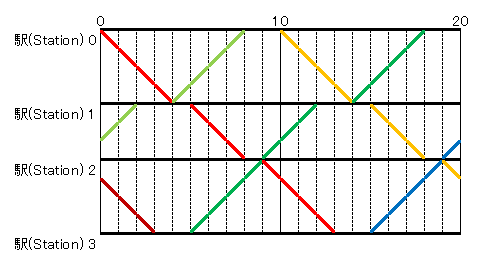
When creating such a timetable, find the minimum sum of the amount of time required for a train to depart station $0$ and reach station $N$, and the amount of time required for a train to depart station $N$ and reach station $0$. It can be proved that, if there exists a timetable satisfying the conditions in this problem, this minimum sum is always an integer.
Formally, the times at which trains arrive and depart must satisfy the following:
* Each train either departs station $0$ and is bound for station $N$, or departs station $N$ and is bound for station $0$.
* Each train takes exactly $A_i$ minutes to run through section $i$. For example, if a train bound for station $N$ departs station $i-1$ at time $t$, the train arrives at station $i$ exactly at time $t+A_i$.
* Assume that a train bound for station $N$ arrives at a station at time $s$, and departs the station at time $t$. Then, the next train bound for station $N$ arrives at the station at time $s+K$, and departs the station at time $t+K$. Additionally, the previous train bound for station $N$ arrives at the station at time $s-K$, and departs the station at time $t-K$. This must also be true for trains bound for station $0$.
* Trains running in opposite directions must not be running on the same single-tracked section (except the stations at both ends) at the same time.
## Constraints
* $1 \leq N \leq 100000$
* $1 \leq K \leq 10^9$
* $1 \leq A_i \leq 10^9$
* $A_i$ is an integer.
* $B_i$ is either $1$ or $2$.
## Input
The input is given from Standard Input in the following format:
$N$ $K$
$A_1$ $B_1$
$A_2$ $B_2$
:
$A_N$ $B_N$
## Partial Score
* In the test set worth $500$ points, all the sections are single-tracked. That is, $B_i = 1$.
* In the test set worth another $500$ points, $N \leq 200$.
[samples]