#nck { width: 30px; height: auto; }One day, Takahashi was given the following problem from Aoki:
* You are given a tree with $N$ vertices and an integer $K$. The vertices are numbered $1$ through $N$. The edges are represented by pairs of integers $(a_i, b_i)$.
* For a set $S$ of vertices in the tree, let $f(S)$ be the minimum number of the vertices in a subtree of the given tree that contains all vertices in $S$.
* There are 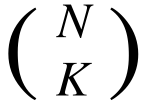 ways to choose $K$ vertices from the trees. For each of them, let $S$ be the set of the chosen vertices, and find the sum of $f(S)$ over all  ways.
* Since the answer may be extremely large, print it modulo $924844033$(prime).
Since it was too easy for him, he decided to solve this problem for all $K = 1,2,...,N$.
## Constraints
* $2 ≦ N ≦ 200,000$
* $1 ≦ a_i, b_i ≦ N$
* The given graph is a tree.
## Input
The input is given from Standard Input in the following format:
$N$
$a_1$ $b_1$
$a_2$ $b_2$
$:$
$a_{N-1}$ $b_{N-1}$
[samples]