5
2 4 1 4
3 3 3 5
1 3 4 6
4 5 3 5
5 5 4 6
3999983 3999976 3999982 3999978 3999977 The figure shows the top-left $5 \times 6$ region of the sky. 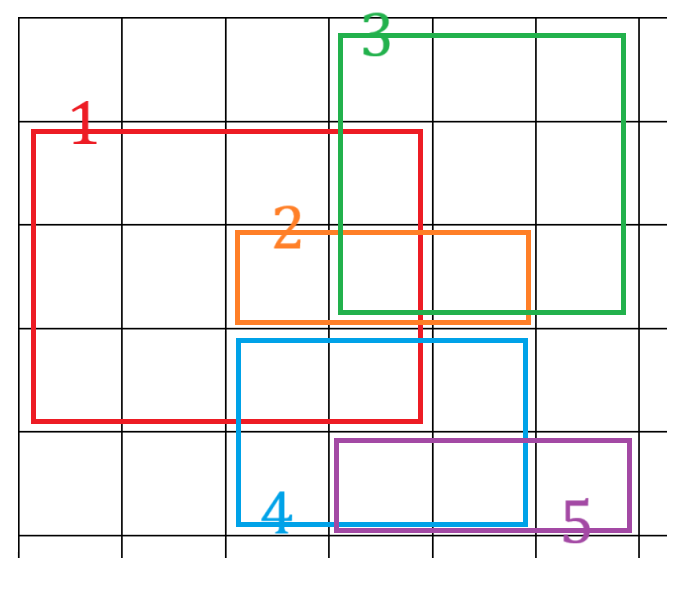 * When cloud $1$ is removed, the number of cells covered by some cloud is $17$, so the number of cells not covered by any cloud is $3999983$. * When cloud $2$ is removed, the number of cells covered by some cloud is $24$, so the number of cells not covered by any cloud is $3999976$. * When cloud $3$ is removed, the number of cells covered by some cloud is $18$, so the number of cells not covered by any cloud is $3999982$. * When cloud $4$ is removed, the number of cells covered by some cloud is $22$, so the number of cells not covered by any cloud is $3999978$. * When cloud $5$ is removed, the number of cells covered by some cloud is $23$, so the number of cells not covered by any cloud is $3999977$.
{
  "problem": {
    "name": "Clouds",
    "description": {
      "content": "The sky is represented by a $2000 \\times 2000$ grid.   When looking up at the sky, the cell at the $r$\\-th row from the top and $c$\\-th column from the left is called $(r,c)$. Currently, there are clo",
      "description_type": "Markdown"
    },
    "platform": "AtCoder",
    "limit": {
      "time_limit": 2000,
      "memory_limit": 262144
    },
    "difficulty": "None",
    "is_remote": true,
    "is_sync": true,
    "sync_url": null,
    "sign": "abc434_d"
  },
  "statements": [
    {
      "statement_type": "Markdown",
      "content": "The sky is represented by a $2000 \\times 2000$ grid.  \nWhen looking up at the sky, the cell at the $r$\\-th row from the top and $c$\\-th column from the left is called $(r,c)$.\nCurrently, there are clo...",
      "is_translate": false,
      "language": "English"
    }
  ]
}