We have an infinite hexagonal grid shown below.
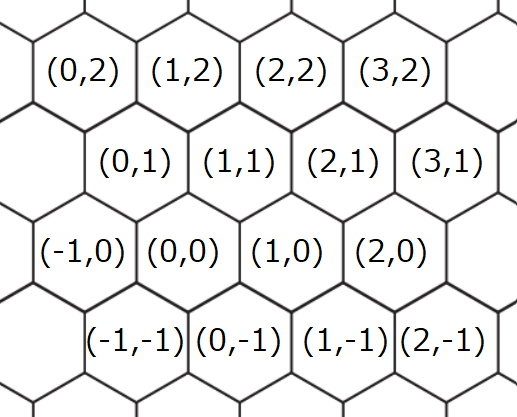
A hexagonal cell is represented as $(i,j)$ with two integers $i$ and $j$.
Cell $(i,j)$ is adjacent to the following six cells:
* $(i-1,j-1)$
* $(i-1,j)$
* $(i,j-1)$
* $(i,j+1)$
* $(i+1,j)$
* $(i+1,j+1)$
Let us define the distance between two cells $X$ and $Y$ by the minimum number of moves required to travel from cell $X$ to cell $Y$ by repeatedly moving to an adjacent cell.
For example, the distance between cells $(0,0)$ and $(1,1)$ is $1$, and the distance between cells $(2,1)$ and $(-1,-1)$ is $3$.
You are given $N$ cells $(X_1,Y_1),\ldots,(X_N,Y_N)$.
How many ways are there to choose one or more from these $N$ cells so that the distance between any two of the chosen cells is at most $D$?
Find the count modulo $998244353$.
## Constraints
* $1 \leq N \leq 300$
* $-10^9\leq X_i,Y_i \leq 10^9$
* $1\leq D \leq 10^{10}$
* $(X_i,Y_i)$ are pairwise distinct.
* All values in the input are integers.
## Input
The input is given from Standard Input in the following format:
$N$ $D$
$X_1$ $Y_1$
$\vdots$
$X_N$ $Y_N$
[samples]