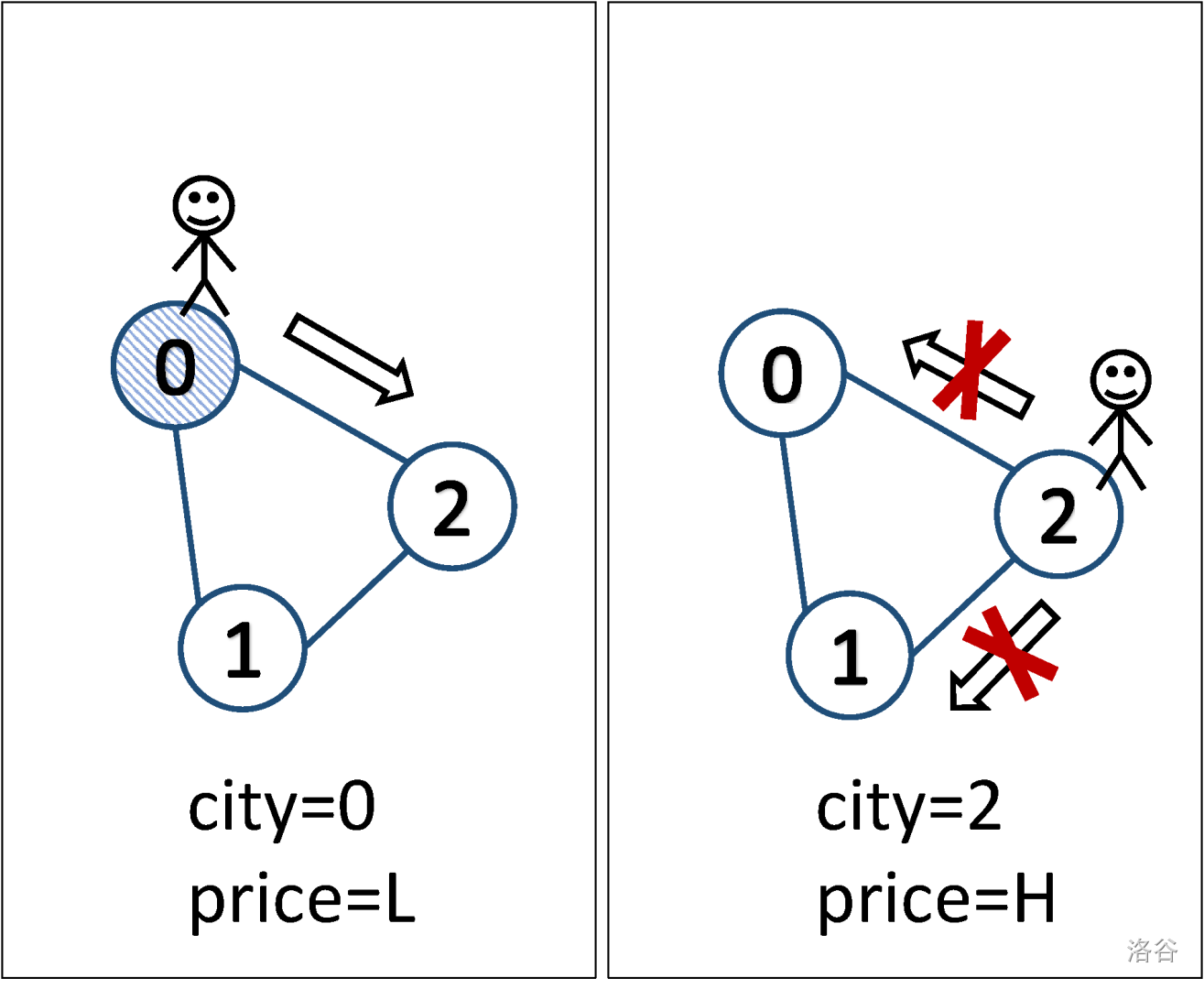
Mr. Lawrence is a traveling merchant who travels between cities and resells products. Basically, to earn from it, he needs to buy products at a very low price and sell them at a higher price. Your task is to tell him whether there exists an endless traveling path that can earn money all the time.
To make things simple, suppose there are $n$ cities named from $0$ to $n-1$ and $m$ undirected roads each of which connecting two cities. Mr. Lawrence can travel between cities along the roads. Initially he is located at city $0$ and each of the city $i$ has a starting price $c_i$, either $\text{Low}$ or $\text{High}$. Due to the law of markets, the price status at city $i$ will change (i.e. $\text{High}$ price will become $\text{Low}$ price, or vice versa) after he departs for a neighboring city $j$ from $i$. (City $j$ is a neighboring city of city $i$ when one of the $m$ roads connects city $i$ and city $j$.) For some reasons (e.g. product freshness, traveling fee, tax), he $\textbf{must}$:
- Start at city $0$ and buy products at city $0$. It is guaranteed that $c_0$ is $\text{Low}$.
- When he arrives some city, he either sells products or buys products. It is not allowed for him to do nothing before he leaves the city.
- After buying products at some city $i$, he must travel to some neighboring city $j$ whose price $c_j$ is $\text{High}$ and sell the products at city $j$.
- After selling products at some city $i$, he must travel to some neighboring city $j$ whose price $c_j$ is $\text{Low}$ and buy the products at city $j$.
As a result, the path will look like an alternation between ``buy at low price`` and ``sell at high price``.
An endless earning path is defined as a path consisting of an endless sequence of cities $p_0, p_1,\dots$ where city $p_i$ and city $p_{i+1}$ has a road, $p_0=0$, and the price alternates, in other words $c_{p_{2k}}=\text{Low}$ (indicates a buy-in) and $c_{p_{2k+1}}=\text{High}$ (indicates a sell-out) for $k\geq0$. Please note here $c_{p_i}$ is the price when $\textbf{arriving}$ city $p_i$ and this value may be different when he arrives the second time.
Your task is to determine whether there exists any such path.
## Input
There are several test cases. The first line contains a positive integer $T$ indicating the number of test cases. Each test case begins with two positive integers $n$ and $m$ indicating the number of cities and the number of roads.
The next line is a string $c$ of length $n$ containing `H` or `L`. The $i$-th ($0\le i<n$) charactor of $c$ is $H$ if the starting price $c_i$ at city $i$ is $\text{High}$. The $i$-th ($0\le i<n$) charactor of $c$ is $L$ if the starting price $c_i$ at city $i$ is $\text{Low}$.
The $i$-th line ($1\le i\le m$) of the following $m$ lines contains two different cities $u_i$ and $v_i$, indicating a road between $u_i$ and $v_i$.
The sum of the values of $n$ over all test cases is no more than $200,000$. The sum of the values of $m$ over all test cases is no more than $200,000$. For each test case, $c_i\in\{\text{H},\text{L}\}$ holds for each $i\in \{0, \ldots, n-1\}$. $c_0$ is always $L$. $0\leq u_i,v_i<n$ and $u_i\neq v_i$ hold for each $i\in \{1,\ldots, m\}$. No two roads connect the same pair of cities.
## Output
For each test case, output a line of ``yes`` or ``no``, indicating whether there exists an endless earning path.
[samples]
## Note
In the first sample test case, the endless earning path is $0\rightarrow 1\rightarrow 2\rightarrow 3\rightarrow 1\rightarrow 2\rightarrow 3\rightarrow \dots$. In the illustration, cities with $\text{Low}$ price are filled with stripe.

In the second sample test case, Mr. Lawrence can only make one move from city $0$ and after that all cities will have $\text{High}$ price. Thus, no further moves can be made.