There is a square box 6 × 6 in size. It contains 36 chips 1 × 1 in size. Those chips contain 36 different characters — "_0_"-"_9_" and "_A_"-"_Z_". There is exactly one chip with each character.
You are allowed to make the following operations: you may choose one of 6 rows or one of 6 columns and cyclically shift the chips there to one position to the left or to the right (for the row) or upwards or downwards (for the column). Those operations are allowed to perform several times.
To solve the puzzle is to shift the chips using the above described operations so that they were written in the increasing order (exactly equal to the right picture). An example of solving the puzzle is shown on a picture below.
<center>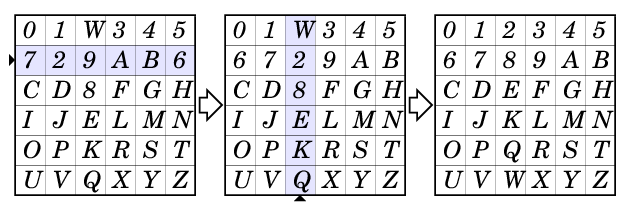</center>Write a program that finds the sequence of operations that solves the puzzle. That sequence **should not necessarily be shortest**, but you should not exceed the limit of 10000 operations. It is guaranteed that the solution always exists.
## Input
The input data are represented by 6 lines containing 6 characters each. They are the puzzle's initial position. Those lines contain each character from the string "_0123456789ABCDEFGHIJKLMNOPQRSTUVWXYZ_" exactly once.
## Output
On the first line print number _n_, which is the number of operations. On the next _n_ lines print the sequence of operations one per line. An operation is described by a word consisting of two characters. The first character shows the direction where the row or the column will be shifted. The possible directions are "_L_", "_R_" (to the left, to the right correspondingly, we shift a row), "_U_", "_D_" (upwards, downwards correspondingly, we shift a column). The second character is the number of the row (or the column), it is an integer from "_1_" to "_6_". The rows are numbered from the top to the bottom, the columns are numbered from the left to the right.
The number of operations should not exceed 104. If there are several solutions, print any of them.
[samples]
**Definitions**
Let $ B \in (\{0,1,\dots,9,A,B,\dots,Z\})^{6 \times 6} $ be the initial $6 \times 6$ grid configuration, where each of the 36 distinct characters appears exactly once.
Let $ G \in (\{0,1,\dots,9,A,B,\dots,Z\})^{6 \times 6} $ be the goal grid defined by row-major ordering:
$$
G[i][j] = \text{char}(i \cdot 6 + j), \quad \text{for } i,j \in \{0,1,2,3,4,5\}
$$
where $\text{char}(k)$ maps $k \in \{0,1,\dots,35\}$ to the $k$-th character in the string `"0123456789ABCDEFGHIJKLMNOPQRSTUVWXYZ"`.
**Operations**
Let a valid operation be one of the following:
- $ \text{RowLeft}(r) $: cyclically shift row $ r \in \{1,\dots,6\} $ one position to the left.
- $ \text{RowRight}(r) $: cyclically shift row $ r \in \{1,\dots,6\} $ one position to the right.
- $ \text{ColUp}(c) $: cyclically shift column $ c \in \{1,\dots,6\} $ one position upward.
- $ \text{ColDown}(c) $: cyclically shift column $ c \in \{1,\dots,6\} $ one position downward.
**Constraints**
1. The sequence of operations must transform $ B $ into $ G $.
2. The total number of operations $ n \leq 10000 $.
**Objective**
Find a sequence $ \mathcal{O} = (o_1, o_2, \dots, o_n) $ of operations such that applying $ o_1, o_2, \dots, o_n $ in order to $ B $ results in $ G $.
Output $ n $, followed by each operation $ o_i $ in the format:
- `"L r"` for RowLeft(r)
- `"R r"` for RowRight(r)
- `"U c"` for ColUp(c)
- `"D c"` for ColDown(c)
where $ r, c \in \{1,2,3,4,5,6\} $.