English · Original
Chinese · Translation
Formal · Original
After the war, the supersonic rocket became the most common public transportation.
Each supersonic rocket consists of **two** "_engines_". Each engine is a set of "_power sources_". The first engine has $n$ power sources, and the second one has $m$ power sources. A power source can be described as a point $(x_i, y_i)$ on a 2-D plane. All points in each engine are different.
You can manipulate each engine **separately**. There are two operations that you can do with each engine. You can do each operation as many times as you want.
1. For every power source as a whole in that engine: $(x_i, y_i)$ becomes $(x_i+a, y_i+b)$, $a$ and $b$ can be any real numbers. In other words, all power sources will be shifted.
2. For every power source as a whole in that engine: $(x_i, y_i)$ becomes $(x_i \cos \theta - y_i \sin \theta, x_i \sin \theta + y_i \cos \theta)$, $\theta$ can be any real number. In other words, all power sources will be rotated.
The engines work as follows: after the two engines are powered, their power sources are being combined (here power sources of different engines may coincide). If two power sources $A(x_a, y_a)$ and $B(x_b, y_b)$ exist, then for all real number $k$ that $0 \lt k \lt 1$, a new power source will be created $C_k(kx_a+(1-k)x_b,ky_a+(1-k)y_b)$. **Then, this procedure will be repeated again with all new and old power sources**. After that, the "_power field_" from all power sources will be generated (can be considered as an infinite set of all power sources occurred).
A supersonic rocket is "_safe_" if and only if after you manipulate the engines, destroying any power source and then power the engine, the power field generated won't be changed (comparing to the situation where no power source erased). Two power fields are considered the same if and only if any power source in one field belongs to the other one as well.
Given a supersonic rocket, check whether it is safe or not.
## Input
The first line contains two integers $n$, $m$ ($3 \le n, m \le 10^5$) — the number of power sources in each engine.
Each of the next $n$ lines contains two integers $x_i$ and $y_i$ ($0\leq x_i, y_i\leq 10^8$) — the coordinates of the $i$\-th power source in the first engine.
Each of the next $m$ lines contains two integers $x_i$ and $y_i$ ($0\leq x_i, y_i\leq 10^8$) — the coordinates of the $i$\-th power source in the second engine.
It is guaranteed that there are no two or more power sources that are located in the same point in each engine.
## Output
Print "_YES_" if the supersonic rocket is safe, otherwise "_NO_".
You can print each letter in an arbitrary case (upper or lower).
[samples]
## Note
The first sample:
<center>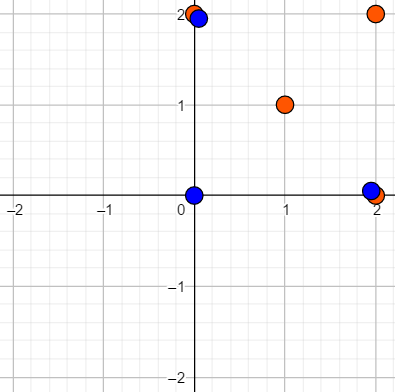 Those near pairs of blue and orange points actually coincide.</center>First, manipulate the first engine: use the second operation with $\theta = \pi$ (to rotate all power sources $180$ degrees).
The power sources in the first engine become $(0, 0)$, $(0, -2)$, and $(-2, 0)$.
<center></center>Second, manipulate the second engine: use the first operation with $a = b = -2$.
The power sources in the second engine become $(-2, 0)$, $(0, 0)$, $(0, -2)$, and $(-1, -1)$.
<center>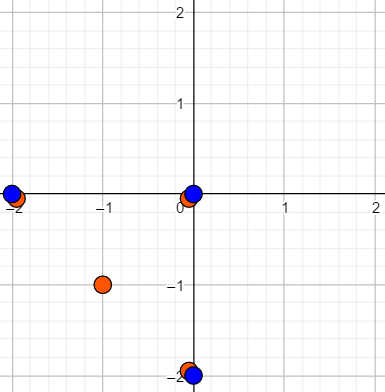</center>You can examine that destroying any point, the power field formed by the two engines are always the solid triangle $(0, 0)$, $(-2, 0)$, $(0, -2)$.
In the second sample, no matter how you manipulate the engines, there always exists a power source in the second engine that power field will shrink if you destroy it.
[{"iden":"statement","content":"战争结束后,超音速火箭成为最常见的公共交通工具。\n\n每艘超音速火箭由*两个*“_引擎_”组成。每个引擎是一组“_动力源_”。第一个引擎有 $n$ 个动力源,第二个引擎有 $m$ 个动力源。一个动力源可以描述为二维平面上的一个点 $(x_i, y_i)$。每个引擎中的所有点均不相同。\n\n你可以分别操纵每个引擎。你对每个引擎可以执行两种操作,每种操作可以执行任意多次。\n\n引擎的工作方式如下:当两个引擎启动后,它们的动力源将被合并(此处不同引擎的动力源可能重合)。如果存在两个动力源 $A (x_a, y_a)$ 和 $B (x_b, y_b)$,那么对于所有满足 $0 lt k lt 1$ 的实数 $k$,都会生成一个新的动力源 $C_k (k x_a + (1 -k) x_b, k y_a + (1 -k) y_b)$。*然后,此过程会再次对所有新生成和原有的动力源重复进行*。之后,将从所有动力源生成“_动力场_”(可视为所有出现的动力源构成的无限集合)。\n\n一艘超音速火箭是“_安全的_”,当且仅当在你操纵引擎后,移除任意一个动力源再启动引擎,生成的动力场不会改变(与没有任何动力源被删除的情况相比)。两个动力场被视为相同,当且仅当其中一个场中的任意动力源也属于另一个场。\n\n给定一艘超音速火箭,判断它是否安全。\n\n第一行包含两个整数 $n$, $m$ ($3 lt.eq n, m lt.eq 10^5$) —— 每个引擎的动力源数量。\n\n接下来的 $n$ 行,每行包含两个整数 $x_i$ 和 $y_i$ ($0 lt.eq x_i, y_i lt.eq 10^8$) —— 第一个引擎中第 $i$ 个动力源的坐标。\n\n接下来的 $m$ 行,每行包含两个整数 $x_i$ 和 $y_i$ ($0 lt.eq x_i, y_i lt.eq 10^8$) —— 第二个引擎中第 $i$ 个动力源的坐标。\n\n保证每个引擎中不存在两个或更多位于同一点的动力源。\n\n如果超音速火箭是安全的,请输出“_YES_”,否则输出“_NO_”。\n\n你可以以任意大小写形式输出每个字母。\n\n第一个样例:\n\n首先,操纵第一个引擎:使用第二个操作,令 $theta = pi$(将所有动力源旋转 $180$ 度)。\n\n第一个引擎中的动力源变为 $(0, 0)$、$(0, -2)$ 和 $(-2, 0)$。\n\n其次,操纵第二个引擎:使用第一个操作,令 $a = b = -2$。\n\n第二个引擎中的动力源变为 $(-2, 0)$、$(0, 0)$、$(0, -2)$ 和 $(-1, -1)$。\n\n你可以验证,无论移除哪一个点,两个引擎形成的动力场始终是实心三角形 $(0, 0)$、$(-2, 0)$、$(0, -2)$。\n\n在第二个样例中,无论你如何操纵引擎,第二个引擎中总存在一个动力源,若将其删除,动力场将缩小。 \n\n"},{"iden":"input","content":"第一行包含两个整数 $n$, $m$ ($3 lt.eq n, m lt.eq 10^5$) —— 每个引擎的动力源数量。接下来的 $n$ 行,每行包含两个整数 $x_i$ 和 $y_i$ ($0 lt.eq x_i, y_i lt.eq 10^8$) —— 第一个引擎中第 $i$ 个动力源的坐标。接下来的 $m$ 行,每行包含两个整数 $x_i$ 和 $y_i$ ($0 lt.eq x_i, y_i lt.eq 10^8$) —— 第二个引擎中第 $i$ 个动力源的坐标。保证每个引擎中不存在两个或更多位于同一点的动力源。"},{"iden":"output","content":"如果超音速火箭是安全的,请输出“_YES_”,否则输出“_NO_”。你可以以任意大小写形式输出每个字母。"},{"iden":"examples","content":"输入\n3 4\n0 0\n0 2\n2 0\n0 2\n2 2\n2 0\n1 1\n输出\nYES\n\n输入\n3 4\n0 0\n0 2\n2 0\n0 2\n2 2\n2 0\n0 0\n输出\nNO"},{"iden":"note","content":"第一个样例: #cf_span(class=[tex-font-size-small], body=[那些靠近的蓝色和橙色点实际上重合。]) 首先,操纵第一个引擎:使用第二个操作,令 $theta = pi$(将所有动力源旋转 $180$ 度)。第一个引擎中的动力源变为 $(0, 0)$、$(0, -2)$ 和 $(-2, 0)$。其次,操纵第二个引擎:使用第一个操作,令 $a = b = -2$。第二个引擎中的动力源变为 $(-2, 0)$、$(0, 0)$、$(0, -2)$ 和 $(-1, -1)$。你可以验证,无论移除哪一个点,两个引擎形成的动力场始终是实心三角形 $(0, 0)$、$(-2, 0)$、$(0, -2)$。在第二个样例中,无论你如何操纵引擎,第二个引擎中总存在一个动力源,若将其删除,动力场将缩小。 "}]}
**Definitions**
Let $ A = \{a_1, a_2, \dots, a_n\} \subset \mathbb{R}^2 $ be the set of power sources of the first engine.
Let $ B = \{b_1, b_2, \dots, b_m\} \subset \mathbb{R}^2 $ be the set of power sources of the second engine.
Let $ \text{conv}(S) $ denote the convex hull of a set $ S \subset \mathbb{R}^2 $.
Let $ \text{aff}(S) $ denote the affine hull of $ S $.
Let $ \text{span}(S) $ denote the linear span of $ S - s_0 $ for some $ s_0 \in S $ (i.e., the vector space generated by differences of points in $ S $).
Define the **closure under affine combinations** of a set $ S \subset \mathbb{R}^2 $ as:
$$
\overline{S} = \left\{ \sum_{i=1}^k \lambda_i s_i \,\middle|\, k \in \mathbb{N},\, s_i \in S,\, \lambda_i \in \mathbb{R},\, \sum_{i=1}^k \lambda_i = 1 \right\}
$$
This is the affine hull of $ S $, i.e., $ \overline{S} = \text{aff}(S) $.
The **power field** generated by engine sets $ A $ and $ B $ is:
$$
\mathcal{P} = \overline{A \cup B}
$$
**Operations allowed on each engine (independently):**
1. **Translation**: Add a fixed vector $ v \in \mathbb{R}^2 $ to all points in the engine.
2. **Linear transformation**: Apply an invertible linear transformation $ T \in \text{GL}(2,\mathbb{R}) $ to all points in the engine.
*(Note: The problem allows arbitrary affine transformations preserving affine structure — translation and linear maps generate the full affine group.)*
Thus, each engine’s set can be transformed to any **affinely equivalent** set:
- $ A \mapsto T(A) + v $, for any $ T \in \text{GL}(2,\mathbb{R}) $, $ v \in \mathbb{R}^2 $.
- Same for $ B $.
**Constraints**
1. $ 3 \leq n, m \leq 10^5 $
2. All points in $ A $ are distinct.
3. All points in $ B $ are distinct.
4. Coordinates are integers in $ [0, 10^8] $.
**Objective**
Determine whether there exist affine transformations $ f, g : \mathbb{R}^2 \to \mathbb{R}^2 $ such that the resulting power field $ \mathcal{P}' = \overline{f(A) \cup g(B)} $ satisfies:
> For every point $ p \in f(A) \cup g(B) $, removing $ p $ does **not** change the affine hull:
$$
\overline{f(A) \cup g(B)} = \overline{(f(A) \cup g(B)) \setminus \{p\}}
$$
That is, **every point in the union is affine-dependent** on the others.
This condition holds **if and only if** the entire set $ f(A) \cup g(B) $ is contained in an **affine subspace of dimension ≤ 1**, and **no point is isolated** — meaning the entire set lies on a single line, and has at least three points (so removing any one still leaves the affine hull unchanged).
But since both $ A $ and $ B $ have at least 3 points, and we can apply arbitrary affine transformations to each, the key is:
> The rocket is **safe** if and only if **both** $ A $ and $ B $ are **collinear** (i.e., all points lie on a straight line), and **after transformation**, their union lies on the same line.
But note: we can independently transform each engine. So:
- We can transform $ A $ to lie on any line $ \ell_1 $,
- We can transform $ B $ to lie on any line $ \ell_2 $,
- We want $ \overline{f(A) \cup g(B)} = \overline{f(A)} = \overline{g(B)} $, and **every point is redundant**.
The only way **removing any point leaves the affine hull unchanged** is if the entire set lies in an affine space of dimension **at most 1**, and has **at least 3 points** (which it does).
Moreover, since we can independently apply affine transformations to $ A $ and $ B $, we can make them lie on **any** two lines. To have their union lie on a single line, we must be able to map **both** $ A $ and $ B $ to subsets of the **same** line.
But any finite set of at least 3 non-collinear points **cannot** be mapped by an affine transformation to a collinear set — because affine transformations preserve collinearity.
Therefore:
- $ f(A) $ is collinear **iff** $ A $ is collinear.
- $ g(B) $ is collinear **iff** $ B $ is collinear.
- $ f(A) \cup g(B) $ lies on a single line **iff** both $ A $ and $ B $ are collinear, and we can align their lines via translation/rotation — which we can, since we can rotate and translate each independently to lie on, say, the x-axis.
So the **necessary and sufficient condition** is:
> Both $ A $ and $ B $ are collinear sets.
Then, after transforming both to lie on the same line, the union is a finite set of points on a line with at least 3 points (since $ n, m \geq 3 $), and thus every point is affine-dependent on the others → removing any point leaves the affine hull unchanged.
If either $ A $ or $ B $ is **not** collinear, then $ \overline{A} $ or $ \overline{B} $ is 2-dimensional. After any affine transformation, $ f(A) $ or $ g(B) $ will still span a 2D affine space. Then $ \overline{f(A) \cup g(B)} $ is 2D. In a 2D affine set with at least 3 non-collinear points, **there exist extreme points** (e.g., vertices of convex hull) whose removal reduces the convex hull (and thus the affine hull). So the condition fails.
Thus:
**Objective (Formal)**
The supersonic rocket is safe **if and only if** both $ A $ and $ B $ are collinear.
That is:
- The points of $ A $ lie on a single straight line.
- The points of $ B $ lie on a single straight line.
**Output**
"YES" if both $ A $ and $ B $ are collinear; otherwise "NO".
---
**Final Formal Statement**
**Definitions**
Let $ A = \{a_1, \dots, a_n\} \subset \mathbb{R}^2 $, $ B = \{b_1, \dots, b_m\} \subset \mathbb{R}^2 $, with $ n, m \geq 3 $, all points distinct.
**Constraints**
As given.
**Objective**
The rocket is safe **iff**
$$
\dim(\text{aff}(A)) \leq 1 \quad \text{and} \quad \dim(\text{aff}(B)) \leq 1
$$
Output "YES" if both conditions hold; otherwise "NO".
API Response (JSON)
{
  "problem": {
    "name": "E. The Supersonic Rocket",
    "description": {
      "content": "After the war, the supersonic rocket became the most common public transportation. Each supersonic rocket consists of **two** \"_engines_\". Each engine is a set of \"_power sources_\". The first engine ",
      "description_type": "Markdown"
    },
    "platform": "Codeforces",
    "limit": {
      "time_limit": 1000,
      "memory_limit": 262144
    },
    "difficulty": "None",
    "is_remote": true,
    "is_sync": true,
    "sync_url": null,
    "sign": "CF1017E"
  },
  "statements": [
    {
      "statement_type": "Markdown",
      "content": "After the war, the supersonic rocket became the most common public transportation.\n\nEach supersonic rocket consists of **two** \"_engines_\". Each engine is a set of \"_power sources_\". The first engine ...",
      "is_translate": false,
      "language": "English"
    },
    {
      "statement_type": "Markdown",
      "content": "[{\"iden\":\"statement\",\"content\":\"战争结束后,超音速火箭成为最常见的公共交通工具。\\n\\n每艘超音速火箭由*两个*“_引擎_”组成。每个引擎是一组“_动力源_”。第一个引擎有 $n$ 个动力源,第二个引擎有 $m$ 个动力源。一个动力源可以描述为二维平面上的一个点 $(x_i, y_i)$。每个引擎中的所有点均不相同。\\n\\n你可以分别操纵每个引擎。你对每个引擎可以执...",
      "is_translate": true,
      "language": "Chinese"
    },
    {
      "statement_type": "Markdown",
      "content": "**Definitions**  \nLet $ A = \\{a_1, a_2, \\dots, a_n\\} \\subset \\mathbb{R}^2 $ be the set of power sources of the first engine.  \nLet $ B = \\{b_1, b_2, \\dots, b_m\\} \\subset \\mathbb{R}^2 $ be the set of p...",
      "is_translate": false,
      "language": "Formal"
    }
  ]
}